

Two professionals talking at a table with a laptop and notebook in a modern office lounge.
Networking Psychology Guide

Content
Most professionals treat networking like collecting business cards—a numbers game where quantity trumps quality. Research from Columbia University's social cognition lab reveals the opposite: the brain processes professional relationships through the same neural pathways as personal friendships, meaning depth matters far more than breadth. When you understand the psychological mechanisms driving connection formation, you stop chasing contacts and start building relationships that actually produce opportunities.
The Science Behind Why Some Connections Stick and Others Don't
Interaction science identifies three non-negotiable elements that determine whether a professional relationship survives past initial contact: perceived similarity, reciprocal disclosure, and repeated exposure under low-stress conditions. A 2019 study published in the Journal of Applied Psychology tracked 847 conference attendees over 18 months and found that only 12% of connections made during formal networking sessions resulted in ongoing relationships. The connections that lasted shared specific characteristics: participants exchanged information of roughly equal value during first conversations, discovered at least two non-obvious commonalities, and reconnected within 14 days.
The brain's default mode network—active during social evaluation—makes snap judgments about trustworthiness within 200 milliseconds of meeting someone. These initial assessments prove remarkably sticky. Neurological studies using fMRI imaging show that contradictory information received later requires significantly more cognitive effort to process and rarely overturns first impressions completely. This explains why recovering from a weak initial interaction feels nearly impossible, while strong openings create generous interpretation of later missteps.
Behavior patterns that predict networking success differ sharply from popular advice. Carnegie Mellon researchers analyzing communication patterns found that professionals who asked follow-up questions—rather than waiting for their turn to speak—formed 40% more durable connections. The mechanism: questions signal attention and trigger reciprocity norms, creating psychological debt that recipients feel compelled to repay.
We systematically underestimate our influence on others. In networking contexts, people assume their requests burden others, when research shows most people feel flattered to be asked and want to help—they simply need clear direction on how.
— Dr. Vanessa Bohns
Trust Formation in Professional Settings: A Timeline Breakdown
Trust doesn't accumulate linearly. It develops through distinct phases, each with specific psychological requirements and failure points. The timeline varies dramatically depending on context, initial credibility signals, and interaction frequency.
| Context Type | Initial Contact Phase | Trust Indicators | Timeline to Established Trust | Key Psychological Factors |
| Industry Conferences | 30-90 seconds to capture attention; competing stimuli high | Asks about your work without pitching; remembers details from earlier in conversation | 3-6 months with consistent follow-up | Proximity effect; shared identity through industry membership; time pressure creates artificial intimacy |
| LinkedIn/Cold Outreach | 3-7 seconds (subject line/first sentence determines open) | Responds substantively rather than perfunctorily; introduces you to others | 6-12 months; requires 5-7 touchpoints | Extreme skepticism bias; must establish credibility before likability; written communication removes nonverbal trust cues |
| Internal Workplace Networking | Ongoing ambient exposure reduces initial barriers | Shares non-public information; advocates for you in your absence | 2-4 months with weekly interaction | Repeated exposure effect; perceived shared fate; organizational proximity implies third-party vetting |
| Referral Introductions | Pre-loaded trust from mutual connection | Treats referral as warm lead rather than cold contact; responds within 48 hours | 1-3 months; mutual connection's reputation transfers partially | Trust transference; social proof; reciprocity obligation to mutual contact |
| Alumni Networks | Shared institutional identity creates baseline affinity | Offers specific help rather than vague "let me know if I can help" | 2-5 months; school prestige affects timeline | In-group bias; nostalgia effect; assumed value alignment through institutional selection |
First Impressions vs. Sustained Trust: What Research Shows
Author: Nathan Brook;
Source: isnvenice.com
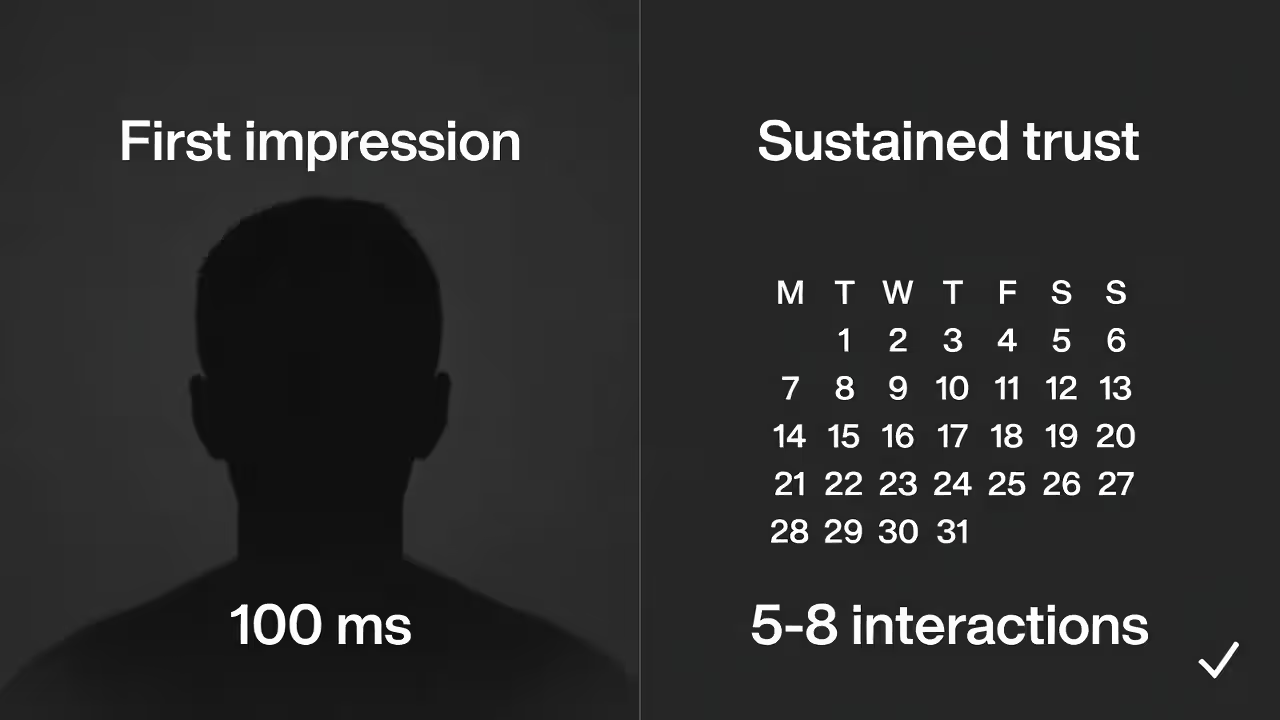
Initial impressions operate through different psychological mechanisms than sustained trust. First encounters activate the brain's threat-detection systems—an evolutionary holdover that evaluated strangers as potential dangers. Modern professional contexts have redirected this circuitry toward evaluating competence and status rather than physical threat, but the rapid, largely unconscious assessment remains.
Princeton psychologists demonstrated that people form stable impressions of competence after viewing faces for just 100 milliseconds. In networking situations, these snap judgments compound with additional signals: handshake firmness, eye contact patterns, vocal tone, and posture. A University of Alabama study found handshake quality alone predicted hiring recommendations with 65% accuracy.
Sustained trust requires entirely different inputs. Long-term professional relationships depend on consistency, demonstrated competence, and reliability over time. The psychological shift happens when your brain moves someone from the "stranger" category to the "known entity" category—typically after 5-8 interactions where behavior matches predictions. Neuroscience research shows this reclassification literally changes which brain regions activate during interactions, shifting from threat-assessment areas to social-reward centers.
The practical implication: you can't build sustained trust without surviving the first-impression filter, but passing that initial test doesn't guarantee long-term relationship development. Many professionals excel at one phase but fail at the other.
Common Trust-Breaking Behaviors Professionals Overlook
Communication research identifies several behaviors that destroy trust while feeling innocuous to the person committing them:
Premature requests for significant favors. Asking for introductions to senior executives or job referrals before establishing reciprocity violates social exchange norms. A Harvard Business School study found that requests made before providing value first succeeded only 8% of the time, while identical requests after value exchange succeeded 42% of the time.
Inconsistent follow-through on minor commitments. Saying "I'll send you that article" and forgetting signals unreliability more powerfully than never offering. The brain weights negative information roughly 3x more heavily than positive information—a phenomenon called negativity bias. Small broken promises accumulate disproportionate psychological weight.
Visible networking calculation. When people sense you're collecting connections instrumentally rather than building genuine relationships, they withdraw. MIT researchers tracking eye gaze patterns at networking events found that people who scanned the room while talking—looking for "better" conversation partners—formed 67% fewer follow-up connections than those who maintained focus on their current conversation partner.
Over-disclosure without reciprocation. Sharing personal challenges or vulnerabilities can build intimacy, but only when the other person reciprocates. One-sided vulnerability creates discomfort rather than connection. Interaction science calls this "reciprocity failure"—when expected social exchange patterns break down, relationships stall.
5 Behavior Patterns That Separate Strategic Networkers from Everyone Else
Author: Nathan Brook;
Source: isnvenice.com
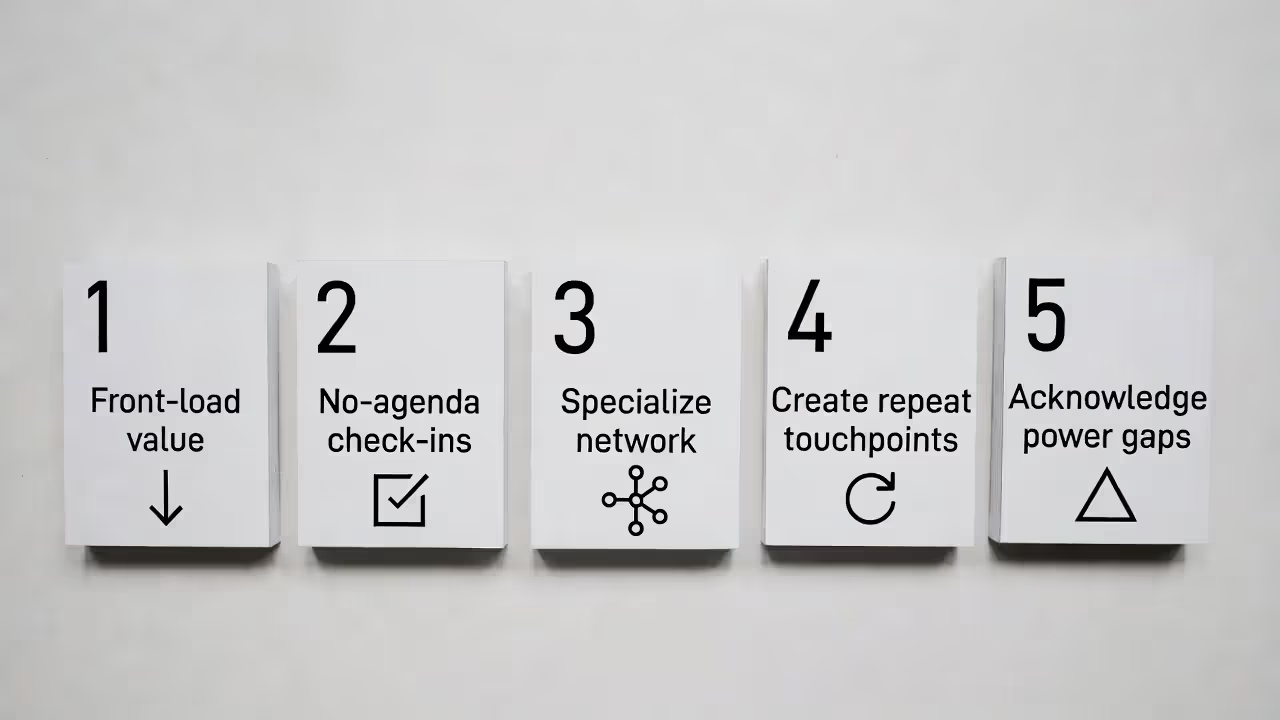
Analysis of networking psychology reveals that successful relationship-builders exhibit specific, measurable behavior patterns that differ from typical approaches:
Pattern 1: They front-load value before requesting anything. Strategic networkers operate on a 5:1 ratio—five value-adding interactions before making any request. Value includes relevant introductions, useful information, thoughtful questions that help the other person clarify their thinking, or amplifying their work to your network. This approach leverages reciprocity norms and establishes credibility before testing the relationship.
Pattern 2: They maintain contact during neutral periods, not just when they need something. Research tracking professional networks over five years found that relationships maintained through "no-agenda" check-ins proved 3.2x more likely to provide career-critical help than relationships contacted only when assistance was needed. The psychological mechanism: regular low-stakes contact prevents relationships from requiring "reactivation energy" and signals genuine interest rather than transactional motivation.
Pattern 3: They specialize their network rather than generalizing it. Contrary to "cast a wide net" advice, effective networkers cultivate depth in specific domains. A Stanford study of venture-backed founders found that those with concentrated networks in their industry sector (knowing many people in one field) raised funding 40% faster than those with dispersed networks across multiple unrelated fields. Specialized networks provide better information quality and stronger reputation effects within relevant communities.
Pattern 4: They create reasons for repeat interaction rather than hoping for organic reconnection. Strategic networkers engineer future touchpoints: "I'm researching X and would value your perspective in a few months once I've made progress," or "I'll send you what I learn from that conference you recommended." This approach exploits the Zeigarnik effect—the psychological tendency to remember incomplete tasks—keeping you present in their mental space.
Pattern 5: They explicitly acknowledge power differentials rather than pretending they don't exist. When reaching out to significantly more senior or accomplished professionals, effective networkers name the asymmetry directly: "I realize your time is valuable and I'm early in my career..." This acknowledgment demonstrates social awareness and reduces the psychological discomfort recipients feel when they can't reciprocate equally. Research on cross-status relationships shows explicit acknowledgment increases response rates by 34%.
Communication Research Applied: What Works in Different Networking Scenarios

Author: Nathan Brook;
Source: isnvenice.com
The same message delivered through different channels or contexts produces wildly different outcomes. Communication research identifies specific tactics matched to particular scenarios:
Cold outreach requires extreme specificity and brevity. Generic messages achieve response rates below 2%, while hyper-specific messages referencing particular work, shared connections, or demonstrated knowledge of the recipient's interests reach 15-23% response rates. The psychological principle: specificity signals genuine interest and proves you've invested effort, triggering reciprocity instincts. Effective cold outreach follows a three-sentence structure: specific reference to their work, clear reason you're reaching out, and concrete low-effort request.
Follow-up messages should reference specific conversation details. Generic "nice to meet you" messages get filed mentally as social pleasantries rather than relationship development. Interaction science shows that referencing specific conversation topics—"I've been thinking about your point regarding X"—demonstrates attention and creates continuity. This approach exploits the psychological principle of consistency: people feel compelled to continue interactions they've already invested in.
Group settings reward facilitators more than self-promoters. Analysis of networking event outcomes found that people who introduced others, asked questions that drew quieter participants into conversation, or synthesized discussion points formed 2.8x more connections than those who dominated conversation about their own work. The mechanism: facilitation demonstrates social intelligence and creates gratitude across multiple people simultaneously.
Virtual networking requires compensating for absent nonverbal cues. Video calls eliminate subtle body language and reduce eye contact (due to camera positioning), removing trust-building signals that operate unconsciously in person. Effective virtual networkers over-index on verbal responsiveness—more frequent acknowledgment, explicit agreement/disagreement, and summarizing to confirm understanding. Research on virtual communication shows these compensatory behaviors restore trust-building capacity to approximately 70% of in-person levels.
The Reciprocity Principle in Modern Professional Networks
Reciprocity—the psychological compulsion to return favors—forms the foundation of networking psychology, but its application has evolved. Traditional reciprocity assumed symmetrical exchange: I help you, you help me. Modern professional networks operate on generalized reciprocity: I help you, you help someone else, and the network eventually helps me through indirect pathways.
Research from the University of Michigan tracking 30,000 professional relationships found that direct reciprocity (A helps B, B helps A) occurred in only 23% of cases, while network-level reciprocity (A helps B, C helps A) occurred in 67% of cases. This finding reshapes networking strategy: value creation for your network broadly proves more effective than targeting specific reciprocity from individuals.
The psychological shift required: comfort with asymmetrical exchanges in individual relationships, trusting that network-level reciprocity will balance over time. This approach conflicts with transactional instincts but aligns with how information-age professional networks actually function.
Social Psychology Mistakes That Sabotage Your Network Growth
Author: Nathan Brook;
Source: isnvenice.com
Even professionals who understand networking psychology intellectually often commit behavioral errors that undermine their efforts:
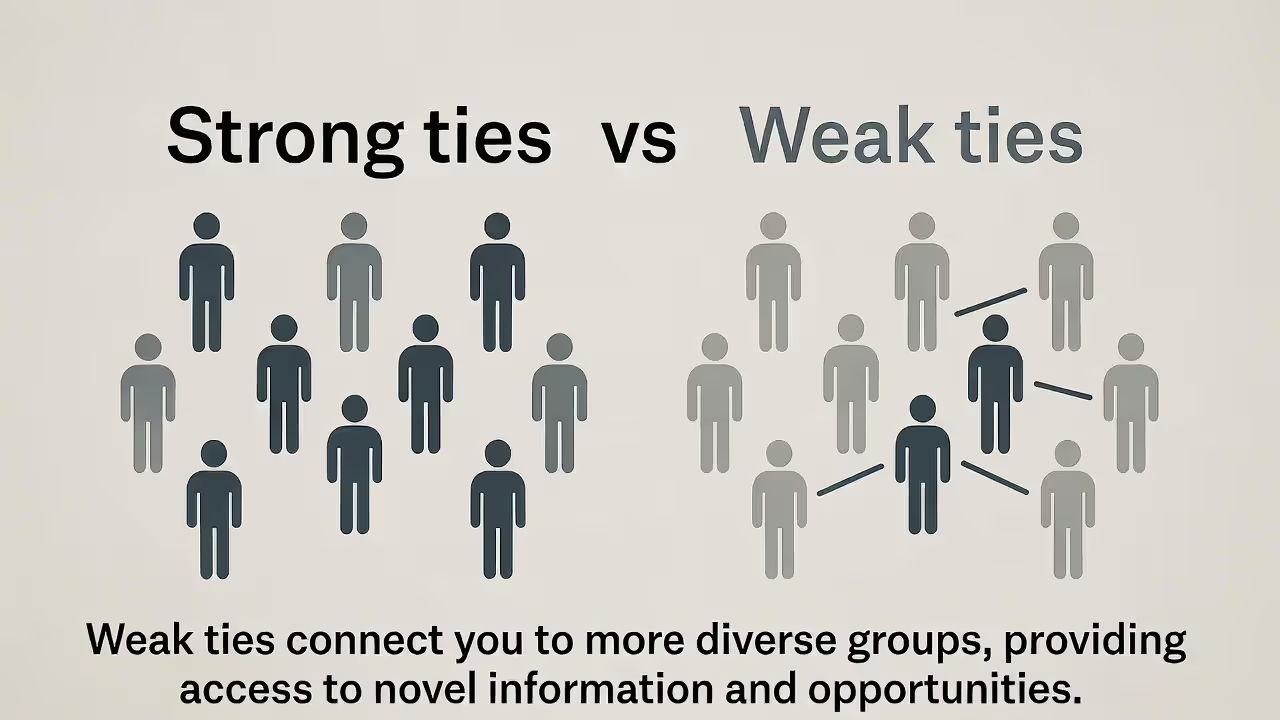
Mistake 1: Treating all connections as equally valuable. Social psychology research distinguishes between strong ties (close relationships with frequent contact) and weak ties (acquaintance-level relationships with infrequent contact). Counterintuitively, weak ties provide more career value for most people. Stanford sociologist Mark Granovetter's research found that 78% of job leads came from weak ties rather than close friends. The mechanism: weak ties connect you to different social circles and novel information, while strong ties mostly know what you already know. Many professionals over-invest in strengthening already-strong relationships while neglecting the weak ties that provide access to new opportunities.
Mistake 2: Seeking advice from people who can't afford to be honest with you. When you ask for feedback or advice from people you've just met or who depend on maintaining positive relationships with you, social desirability bias prevents honest input. Research on advice-seeking shows people systematically provide more optimistic, less critical feedback to acquaintances than to close friends. Strategic networkers distinguish between relationships for honest feedback (strong ties with no conflict of interest) and relationships for access to opportunities (weak ties and professional contacts).
Mistake 3: Confusing visibility with relationship-building. Posting on LinkedIn, attending events, and sending updates creates visibility—people know you exist. But visibility doesn't build relationships. A three-year study of professional social media use found no correlation between posting frequency and network strength, but strong correlation between direct message exchanges and relationship depth. The psychological distinction: broadcast communication triggers passive recognition, while dyadic communication triggers active relationship formation.
Mistake 4: Avoiding reconnection after long gaps. Many professionals assume that contacting someone after months or years of silence will seem awkward or opportunistic, so they avoid it entirely. Research on dormant relationships shows the opposite: people generally respond positively to reconnection attempts, and dormant ties (relationships that have lapsed but are reactivated) often provide more value than continuously active relationships. The psychological principle: people appreciate being remembered and rarely interpret reconnection as negatively as the person initiating contact fears.
Mistake 5: Neglecting the network maintenance workload. Professional networks decay without maintenance. Studies tracking relationship strength over time show that connections lose approximately 30% of their strength annually without interaction. A network of 100 meaningful relationships requires roughly 200 touchpoints per year to maintain (averaging two per relationship)—approximately four hours per week. Most professionals underestimate this time requirement and watch their networks atrophy through neglect.
How to Audit Your Networking Approach Using Behavioral Science
Author: Nathan Brook;
Source: isnvenice.com
Strategic improvement requires measurement. Apply these behavioral science frameworks to evaluate and refine your networking approach:
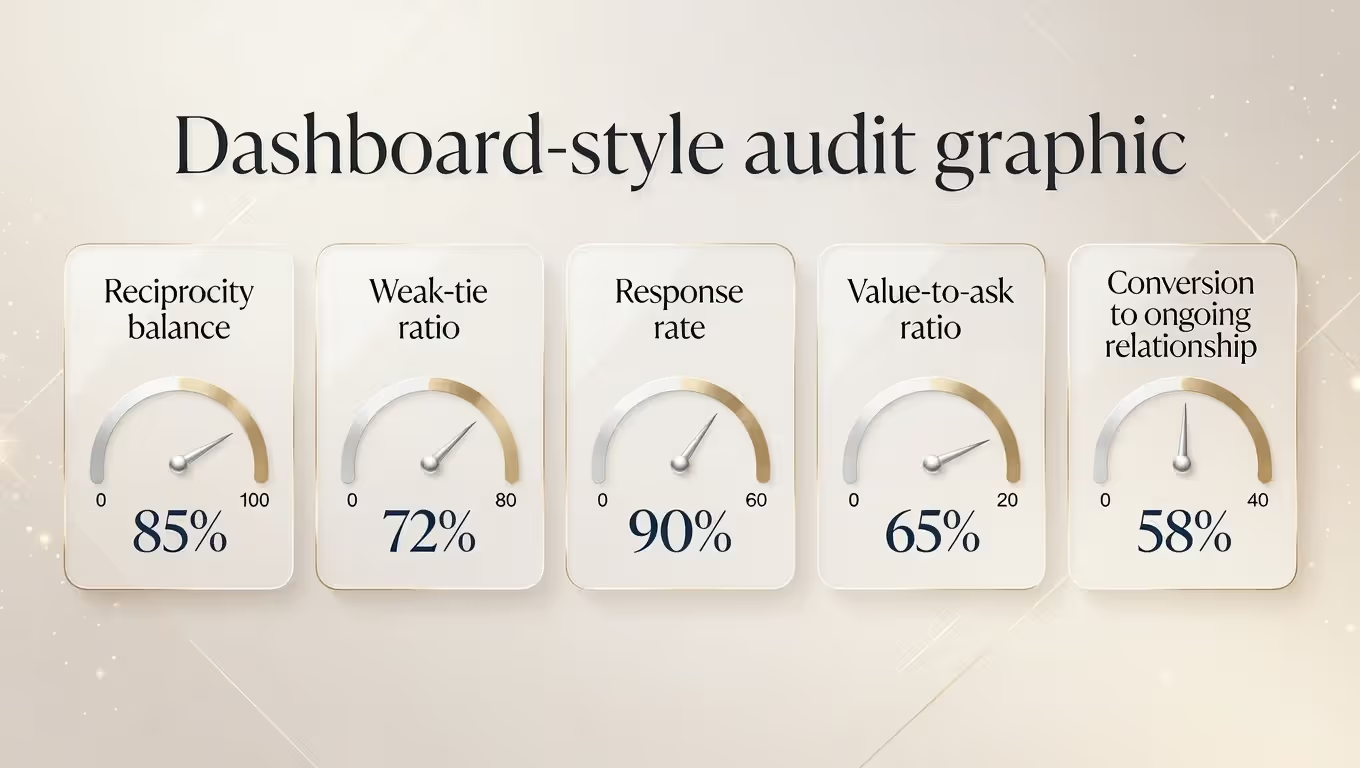
Audit 1: Map your reciprocity balance. For your 20 most important professional relationships, categorize interactions over the past year: value you provided, value you received, requests you made, requests they made. Healthy relationships show rough balance over time (not necessarily within each interaction). Relationships skewed heavily toward you receiving value signal either unrecognized debt or unsustainable extraction. Relationships where you've provided disproportionate value represent underutilized assets—you've built reciprocity capital but haven't leveraged it.
Audit 2: Calculate your weak-tie ratio. Count your professional contacts in three categories: strong ties (communicate monthly or more), weak ties (communicate quarterly to annually), and dormant ties (no contact in past year). Research suggests optimal ratios of approximately 10-15% strong ties, 40-50% weak ties, and 35-45% dormant ties. Ratios skewed heavily toward strong ties suggest insularity and limited access to novel information. Excessive dormant ties suggest poor network maintenance.
Audit 3: Track response rates and time-to-response. For outreach attempts (cold emails, reconnection messages, requests for introductions), measure response rate and average response time. Response rates below 20% for warm contacts or below 5% for cold contacts indicate messaging problems—either poor targeting, weak value proposition, or ineffective communication. Response times longer than one week suggest low relationship priority; you're not top-of-mind for your contacts.
Audit 4: Assess your value-to-ask ratio. Count value-adding interactions (sharing useful information, making introductions, offering help) versus asks (requesting favors, introductions, advice) over the past quarter. Effective networkers maintain ratios of at least 3:1, preferably 5:1. Ratios below 2:1 signal transactional approach that triggers resistance.
Audit 5: Evaluate conversion from meeting to ongoing relationship. Of people you met in the past year through networking activities, what percentage resulted in at least three subsequent interactions? Conversion rates below 10% suggest either poor initial targeting (meeting people unlikely to become valuable connections) or weak follow-up execution. Rates above 30% indicate effective relationship development.
These audits reveal specific failure points rather than vague "I should network more" conclusions. A professional who discovers they have strong follow-up but poor initial targeting needs different solutions than someone who meets relevant people but fails to maintain contact.
FAQ: Networking Psychology Explained
Networking psychology transforms professional relationship-building from random social activity into strategic practice. The research consistently shows that success comes not from personality traits or natural charisma, but from understanding and applying specific behavioral principles: reciprocity, consistency, strategic vulnerability, and context-appropriate communication.
The professionals who build valuable networks share common patterns: they provide value before requesting it, maintain contact during neutral periods, specialize rather than generalize their connections, and engineer future touchpoints systematically. They understand that trust formation follows predictable timelines and that different contexts require different approaches.
Start by auditing your current approach using the frameworks outlined above. Identify specific failure points—poor initial targeting, weak follow-up, imbalanced reciprocity, or inadequate network maintenance. Then apply targeted corrections based on behavioral science rather than generic networking advice. Small adjustments to reciprocity ratios, contact frequency, or message specificity compound into significantly stronger professional networks over time.
The goal isn't to manipulate people through psychological tricks. It's to align your networking behavior with how human psychology actually works, making relationship-building more effective and more authentic simultaneously.