

How to Use Networking Conversation Frameworks for Any Professional Setting
How to Use Networking Conversation Frameworks?

Content
Most professionals walk into networking events armed with nothing but hope and a stack of business cards. They scan the room, spot someone interesting, approach with sweaty palms, and then... freeze. The conversation stumbles through weather commentary before dying an awkward death near the refreshment table.
This scenario repeats itself thousands of times daily because people treat networking like improvisation when it actually benefits from structure. Professional communicators, successful entrepreneurs, and career coaches have developed specific frameworks that remove guesswork and replace anxiety with confidence.
Why Structured Approaches Beat Winging It in Professional Networking
The data tells a clear story. Research from the Harvard Business Review found that professionals who prepare structured talking points before networking events report 40% more meaningful connections than those who improvise. Meanwhile, a study tracking 500 sales professionals showed that those using repeatable conversation frameworks closed 27% more deals from networking introductions.
Frameworks work because they free up mental bandwidth. When you're not scrambling for what to say next, you can actually listen. You notice body language cues. You remember names and details. The cognitive load of conversation planning happens before the event, leaving your brain available for genuine connection during it.
Think of frameworks as training wheels that eventually disappear. Pianists practice scales before improvising jazz. Comedians rehearse setups before riffing with audiences. Similarly, networking conversation frameworks provide structure until the patterns become second nature. After enough repetitions, you'll adapt them instinctively without feeling scripted.
The alternative—winging it—forces your brain into constant problem-solving mode. Should I ask about their company now? Was that joke appropriate? Did I just interrupt them? This mental juggling act prevents the relaxed presence that actually builds rapport.
Structured approaches also create consistency. When you have a reliable framework, every conversation has a foundation. Some will soar into genuine friendship or lucrative partnerships. Others will remain cordial but brief. Either outcome is fine because you've maximized the potential of each interaction without leaving opportunities on the table through poor execution.
7 Battle-Tested Communication Models for Different Networking Scenarios
Different situations demand different frameworks. A trade show conversation differs from a coffee meeting, which differs from a LinkedIn message exchange. Below are seven communication models that cover the most common networking scenarios professionals encounter.

Author: Lucas Hayes;
Source: isnvenice.com
The FORD Method for Initial Conversations
FORD stands for Family, Occupation, Recreation, Dreams. This framework sequences topics from safe to meaningful, building rapport gradually.
Start with Family—not invasive questions about their kids, but observations that invite sharing: "Did you travel far to get here?" or "Are you local to the area?" This establishes basic common ground.
Move to Occupation once initial comfort exists: "What brings you to this event?" or "What's keeping you busy these days?" Notice these questions avoid the dreaded "So what do you do?" which immediately triggers sales mode in many people.
Recreation opens up personality: "How do you spend time when you're not working?" People relax when discussing hobbies because there's no professional posturing involved.
Dreams is where real connection happens: "What's next for you?" or "Where do you see your industry heading?" These forward-looking questions reveal values and ambitions, creating opportunities for meaningful follow-up.
The FORD method works best at conferences, industry mixers, and anywhere you're meeting someone completely new with limited time.
The AID Framework for Industry Events
AID stands for Acknowledge, Inquire, Develop. This framework suits situations where you're approaching someone mid-event, perhaps standing alone or between conversations.
Acknowledge makes your approach feel natural rather than intrusive: "That panel discussion on supply chain automation was fascinating" or "I couldn't help overhearing your comment about remote team management." You're establishing shared context.
Inquire shows genuine interest: "What was your take on the speaker's prediction about AI adoption?" or "How are you handling that challenge in your organization?" The key is asking something that requires more than yes/no answers.
Develop means expanding the conversation beyond the initial topic: "That's interesting—how did you get into this field?" or "Have you seen other companies trying similar approaches?" You're building depth while watching for signals about whether they want a brief chat or extended conversation.
AID works particularly well at conferences, seminars, and professional development events where shared experience provides natural conversation fuel.
The LEAP Approach for Follow-Up Interactions
LEAP stands for Link, Explore, Advance, Plan. This framework transforms initial meetings into ongoing relationships.
Link references your previous interaction: "I've been thinking about your comment on customer retention strategies since we met at the marketing summit." This shows you actually listened and remembered.
Explore digs deeper into topics you touched on briefly: "You mentioned experimenting with subscription models—how's that been working out?" You're demonstrating sustained interest beyond surface-level networking.
Advance introduces new value: "I came across this article on subscription pricing psychology and thought of our conversation" or "Would you be interested in hearing how we solved a similar challenge?" You're becoming a resource, not just a contact.
Plan creates the next touchpoint: "I'd love to continue this conversation—are you free for a 20-minute call next week?" or "I'm organizing a small roundtable on this topic in March—would that interest you?" Specific proposals work better than vague "let's stay in touch" statements.
LEAP transforms one-time meetings into relationships through systematic follow-up that feels personal rather than transactional.
The BRIDGE Framework for Cross-Industry Networking
BRIDGE stands for Background, Relevance, Interest, Discovery, Growth, Exchange. Use this when networking outside your immediate industry.
Background establishes your context briefly: "I work in healthcare technology, specifically patient engagement platforms." Clear and concise beats detailed explanations.
Relevance explains why you're talking to someone from a different field: "I'm curious about how retail companies handle customer loyalty because we face similar challenges with patient retention."
Interest shows genuine curiosity: "What's the biggest shift you're seeing in retail customer behavior?" You're learning, not selling.
Discovery identifies unexpected commonalities: "That's fascinating—we're dealing with almost identical data privacy concerns in healthcare."
Growth explores how different industries solve similar problems: "How do retail companies balance personalization with privacy concerns?"
Exchange offers your perspective: "In healthcare, we've found that transparent data policies actually increase engagement—I wonder if that would translate to retail."
BRIDGE works when you're deliberately expanding your network beyond your industry bubble, which often yields the most innovative insights.
Author: Lucas Hayes;
Source: isnvenice.com
The CONNECT Framework for Virtual Networking
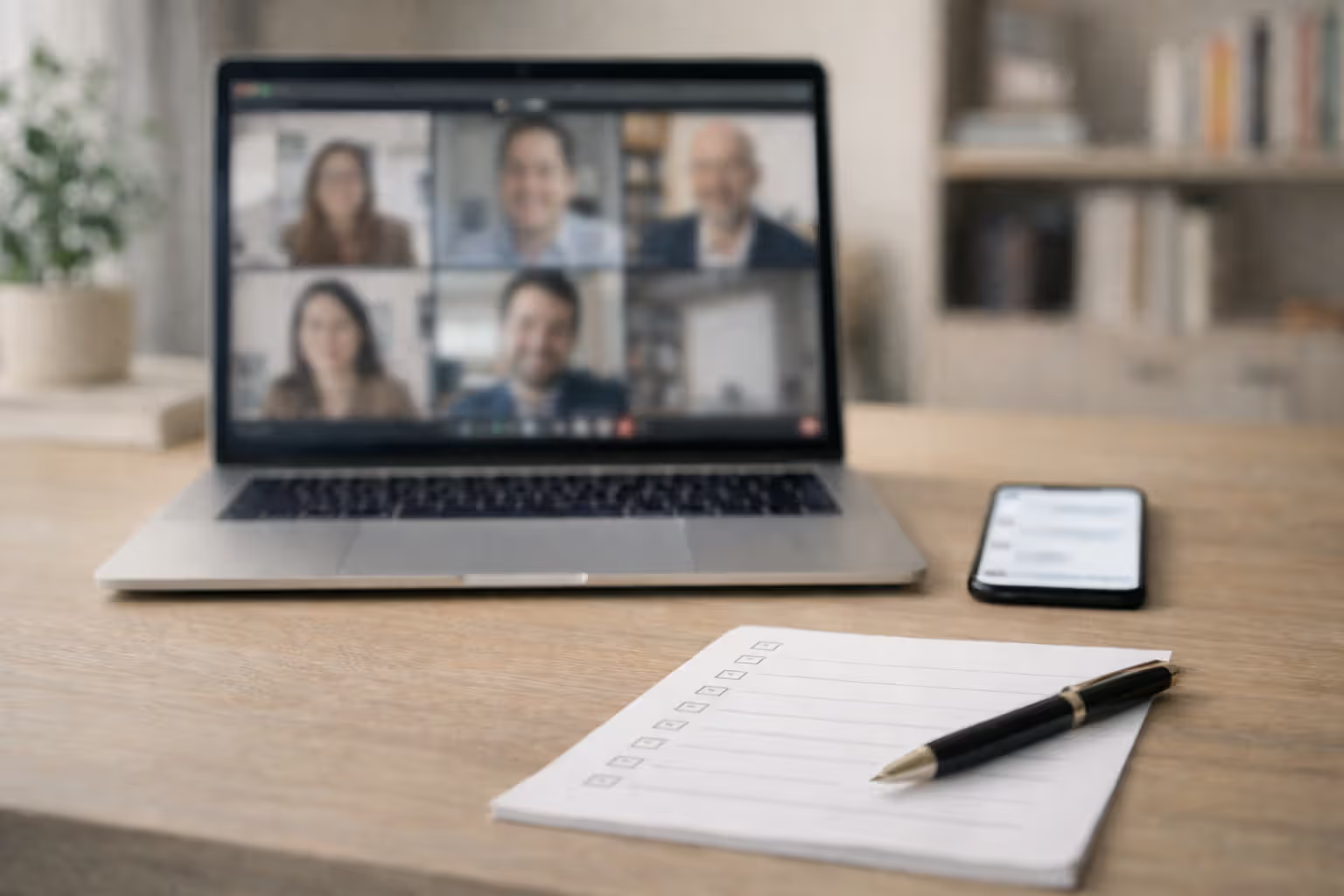
CONNECT stands for Context, Open, Notice, Navigate, Engage, Close, Track. Virtual networking requires adapted frameworks because digital environments change interaction dynamics.
Context matters more virtually: "I'm joining from Seattle—where are you?" establishes basic orientation that happens naturally in person.
Open with energy that compensates for screen distance: "I'm excited to connect—I've been following your company's expansion into sustainable packaging."
Notice and name what you see: "I see from your background you're in a home office too—how's the remote work transition been for you?" Acknowledging the medium creates authenticity.
Navigate technical issues gracefully: "Looks like we have a slight lag—I'll pause between thoughts to make sure we're tracking together." This prevents awkward interruptions.
Engage with more explicit turn-taking: "I'd love to hear your perspective on this" clearly signals when you're inviting response.
Close with specific next steps: "I'll send you that resource link right after this call" creates immediate follow-through.
Track means actually doing what you promised: Send that email within 24 hours while the conversation is fresh.
The VALUE Framework for Approaching Senior Professionals
VALUE stands for Validate, Ask, Listen, Understand, Extend. This framework helps when networking "up" to more experienced professionals.
Validate their expertise without fawning: "Your work on organizational transformation has influenced how I think about change management." Specific beats generic praise.
Ask for insight, not favors: "What do you wish you'd known earlier in your career about building strategic partnerships?" People enjoy sharing wisdom more than granting requests.
Listen actively with follow-up questions: "When you mention timing being critical, what signals do you look for?" This proves you're processing, not just waiting to talk.
Understand their constraints: Senior professionals have limited time. "I know you're busy—I really appreciate these ten minutes" acknowledges reality.
Extend value where possible: "I recently read a case study on digital transformation in manufacturing that connects to what you're working on—I'll send you the link." Even junior professionals can offer relevant information.
VALUE works when approaching executives, industry leaders, or anyone significantly more experienced than you.
The SPARK Framework for Rekindling Dormant Connections
SPARK stands for Specific, Personal, Authentic, Relevant, Kind. Use this when reaching out to contacts you haven't spoken with in months or years.
Specific references prevent "mass email" feelings: "I still remember our conversation about the challenges of scaling customer service during your Series B" beats "Hope you're doing well."
Personal means addressing their situation: "I saw your company just opened a Chicago office—congratulations on the expansion!"
Authentic explains your real reason for reaching out: "I'm exploring opportunities in the fintech space and immediately thought of your expertise" is honest and clear.
Relevant offers something useful: "I came across this article on fintech regulation changes and thought you'd find it valuable given your company's recent expansion."
Kind means no immediate ask: "No agenda here—just wanted to reconnect and see how things are going for you." Pressure-free outreach gets better responses.
SPARK revives relationships that have naturally faded without awkwardness or forced "just checking in" messages.
| Framework | Best Use Case | Time Investment | Difficulty Level | Key Conversation Phases |
| FORD | Initial meetings at events | 5-10 minutes | Beginner | Rapport building → Discovery → Connection |
| AID | Industry conferences/seminars | 3-7 minutes | Beginner | Context → Inquiry → Depth |
| LEAP | Follow-up after initial meeting | 15-30 minutes | Intermediate | Reference → Exploration → Value → Commitment |
| BRIDGE | Cross-industry networking | 10-20 minutes | Intermediate | Context → Curiosity → Common ground |
| CONNECT | Virtual networking calls | 15-45 minutes | Intermediate | Orientation → Engagement → Follow-through |
| VALUE | Approaching senior professionals | 10-15 minutes | Advanced | Recognition → Inquiry → Contribution |
| SPARK | Rekindling dormant contacts | 5-10 minutes (initial) | Advanced | Memory → Relevance → Reconnection |
How to Build Your Personal Networking Script Library
Author: Lucas Hayes;
Source: isnvenice.com
Frameworks provide structure, but scripts give you exact language. The goal isn't memorizing word-for-word speeches—it's having proven phrases ready so you're never starting from scratch.
Customizing Templates for Your Industry
Generic networking advice fails because context matters enormously. A software developer networking at a tech conference needs different scripts than a commercial real estate broker at a chamber of commerce mixer.
Start by identifying your three most common networking scenarios. For a marketing consultant, this might be: agency networking events, client industry conferences, and virtual coffee chats with referral partners. For each scenario, note what information you need to convey (your specialty, current projects, ideal collaborations) and what you need to learn (their challenges, upcoming initiatives, decision-making process).
Build scripts around these specific needs. A marketing consultant at an agency event might use: "I specialize in content strategy for B2B SaaS companies—specifically helping them build thought leadership that actually generates pipeline. What's your agency's sweet spot?" This script efficiently communicates specialization while inviting reciprocal sharing.
The same consultant at a client's industry conference would adjust: "I work with several companies in this space on their content marketing—I'm here to better understand the challenges you're all facing. What sessions are you most interested in today?" Different context, different script, same underlying framework.
Test your scripts with trusted colleagues before using them in high-stakes situations. What sounds smooth in your head might feel awkward spoken aloud. Refine based on actual responses you receive.
Opening Lines That Actually Work
Most networking conversations die in the first 15 seconds because opening lines are either too aggressive ("Let me tell you about my company") or too generic ("Some weather we're having").
Effective opening lines create easy entry points for response. Here are eight tested examples for different contexts:
At conference sessions: "What brought you to this particular session?" (Reveals their interests immediately)
Near event registration: "Is this your first time at this event, or are you a regular?" (Works regardless of their answer)
At industry mixers: "How do you know the organizers?" (Uncovers connections and context)
Virtual networking rooms: "I'm curious what everyone's working on lately—I'll start: we're in the middle of a product launch that's teaching me patience." (Models vulnerability and invites sharing)
After presentations: "I appreciated your point about data privacy—are you seeing clients prioritize that more this year?" (Shows you paid attention and invites expertise)
Coffee meetings: "Before we dive in, I'm curious—what's taking up most of your energy these days?" (Opens space for them to share what matters most right now)
Following up after initial meeting: "I've been thinking about your comment on remote team dynamics—have you found any approaches that actually work?" (References specific content from previous conversation)
Reconnecting after time: "I saw your post about the company's pivot to enterprise clients—that must be quite a transition. How's it going?" (Shows you've stayed aware of their journey)
Notice none of these scripts ask "What do you do?" That question triggers rehearsed elevator pitches that kill genuine conversation. Better questions invite storytelling, reveal current priorities, and create natural dialogue flow.
Keep a running document of opening lines that work for you. Note the context where you used them and the response you received. Over time, you'll build a personal library matched to your style and situations.
Common Dialogue Structure Mistakes That Kill Connections
Even with good frameworks, specific execution errors sabotage networking conversations. Here are seven mistakes professionals make repeatedly, with corrections.
Mistake 1: The premature pitch. You meet someone, learn they might need your services, and immediately launch into what you offer. This feels transactional and desperate.
Before: "Oh, you're struggling with employee retention? We have a platform that solves exactly that problem. Let me tell you about our features..."
After: "Employee retention is such a complex challenge right now. What approaches have you tried so far?" (Understand before offering solutions)
Mistake 2: The interview interrogation. You ask question after question without sharing anything about yourself, making the other person feel like they're being mined for information.
Before: "What's your role? What projects are you working on? What tools do you use? What's your budget cycle?"
After: "I'm working on improving our customer onboarding process—it's been interesting figuring out where people get stuck. What's keeping you busy these days?" (Share, then ask)
Mistake 3: The conversation hog. You dominate talking time, treating networking as a chance to broadcast rather than connect.
Rule of thumb: If you've talked for more than 60 seconds without the other person contributing, pause and invite their perspective. "But I'm curious about your experience with this—what's worked for you?"
Mistake 4: The topic jumper. You bounce between unrelated subjects without developing any single thread, leaving both parties confused about what you actually discussed.
Before: "So you're in finance... I just read about cryptocurrency... Speaking of which, have you traveled internationally lately? ... Oh, that reminds me of this podcast..."
After: Pick one topic and explore it: "You mentioned international expansion—what's been the most surprising challenge?" Then follow that thread before introducing new subjects.
Mistake 5: The value vacuum. You extract information, contacts, and insights without offering anything in return, positioning yourself as a taker.
Correction: Always bring something to conversations. An article, an introduction, a perspective, a compliment—anything that makes the interaction mutually beneficial. "This reminds me of a case study I read last week—I'll send you the link" plants seeds of reciprocity.
Mistake 6: The vague close. The conversation ends well, but you part with "Let's stay in touch" or "We should grab coffee sometime"—phrases that sound nice but create no actual next steps.
Before: "This was great—we should definitely connect again soon!"
After: "I'd like to continue this conversation—are you free for a 20-minute call next Tuesday or Wednesday afternoon?" (Specific proposal, defined timeframe)
Mistake 7: The ghost follow-up. You promise to send information, make an introduction, or follow up with details, then never do it. This destroys trust faster than not promising anything at all.
Correction: Set a phone reminder immediately after the conversation. Send promised materials within 24 hours while the interaction is fresh in both your minds. If you can't deliver on something, acknowledge it: "I looked for that article I mentioned but can't locate it—if I find it, I'll send it along."
These mistakes share a common thread: they prioritize your agenda over genuine connection. Effective networking conversation frameworks keep both parties' interests balanced throughout the interaction.

Author: Lucas Hayes;
Source: isnvenice.com
Planning Your Interaction Strategy Before Events
The best networking happens before you arrive at the event. Preparation transforms random encounters into strategic relationship building.
Start with clear objectives. "Network more" is too vague to guide behavior. Better goals: "Have substantive conversations with three people in the healthcare technology space" or "Reconnect with five former colleagues I haven't spoken with in six months" or "Learn about three companies' approaches to remote team management."
Specific goals shape how you spend your time. If you're focused on healthcare technology, you'll gravitate toward those conversations rather than spreading yourself thin across every interaction. You'll also recognize success—three substantive conversations is measurable, unlike the fuzzy "good networking."
Research attendees when possible. Many conferences publish attendee lists or have event apps showing who's registered. Identify 5-10 people you'd genuinely like to meet. Learn enough about them to ask informed questions: recent company news, published articles, shared connections. This isn't stalking—it's preparation that enables better conversations.
Prepare your own introduction. You need a clear, concise answer to "What do you do?" that invites follow-up questions rather than ending conversation. Compare these:
Conversation killer: "I'm a consultant." (Too vague, nowhere to go)
Conversation starter: "I help manufacturing companies reduce supply chain disruptions—it's been fascinating watching how companies adapted during the pandemic." (Specific enough to be interesting, open enough to invite questions)
As Keith Ferrazzi, author of "Never Eat Alone," notes:
The currency of real networking is not greed but generosity. Networking is about establishing genuine relationships, and that takes time and preparation. You can't fake genuine interest, and you can't build real relationships without investing the effort to understand people before you meet them.
— Keith Ferrazzi
Plan your energy management. Networking is cognitively demanding, especially for introverts. Schedule breaks. Identify quiet spaces where you can recharge. Give yourself permission to have fewer, deeper conversations rather than exhausting yourself with superficial exchanges.
Prepare conversation exit strategies. You'll encounter situations where you need to politely move on—someone who dominates your time, conversations that aren't mutually beneficial, or simply needing to meet your goal of connecting with specific people. Have phrases ready: "I've enjoyed talking with you—I'm going to circulate a bit more, but let's definitely stay in touch" or "I don't want to monopolize your time, and I see someone I need to catch before they leave."
Create a post-event follow-up system. Decide before the event how you'll capture notes (phone notes, business card backs, event app), when you'll do follow-up (within 24 hours works best), and what your follow-up will include (reference to specific conversation points, promised materials, next step proposals).
Bring conversation tools. Have your phone ready to share contact information, connect on LinkedIn immediately, or schedule follow-up meetings while you're both standing there. Fumbling with technology breaks conversational momentum.
The goal of conversation planning isn't to script every moment—it's to handle logistics and preparation in advance so your mental energy during the event focuses entirely on genuine connection.
Frequently Asked Questions About Networking Conversation Frameworks
Networking conversation frameworks transform uncomfortable social gambling into strategic relationship building. They don't eliminate the human element—they amplify it by removing the cognitive burden of figuring out what to say next.
Start with one framework that matches your most common networking scenario. Practice it until the structure becomes invisible and your natural conversational style emerges within it. Build your script library with opening lines and transitions that feel authentic to you. Learn from mistakes, refine your approach, and gradually expand your framework repertoire.
The goal isn't perfect execution. Some conversations will flow effortlessly while others remain cordial but brief. Frameworks simply ensure you maximize the potential of each interaction rather than leaving opportunities on the table through poor preparation or awkward execution.
Professional networking is a skill that improves with deliberate practice. Frameworks provide the structure for that practice, transforming random encounters into systematic relationship building that compounds over time.