

Measure what attendees do—not just that they showed up.
Event Engagement Metrics Guide

Content
Most event organizers spend weeks planning sessions, speakers, and catering, then measure success by counting heads. You packed 500 people into a ballroom—congratulations. But did anyone actually care? Did they network? Learn something? Take action afterward?
The gap between attendance and genuine engagement costs companies millions in wasted event budgets. Understanding which metrics reveal true attendee value separates strategic event programs from expensive networking happy hours that nobody remembers.
Why Most Event Organizers Track the Wrong Engagement Data
Registration numbers look impressive in board presentations. So do social media mentions and booth traffic counts. These vanity metrics feel productive to track because they're easy to collect and always trend upward with enough promotion.
The problem: none of these numbers tell you whether your event actually worked.
A pharmaceutical company once celebrated their 2,000-person conference as their "most successful ever" based on attendance. When they finally examined session completion rates, they discovered 60% of attendees left after the opening keynote. Their multi-million-dollar agenda played to half-empty rooms. Attendance masked complete failure.
Stakeholders care about business outcomes, not participation trophies. Your CFO wants to know if the event generated pipeline. Your CEO asks whether strategic partnerships formed. Your sales team needs qualified leads, not badge scans.
Common tracking mistakes include measuring app downloads instead of app usage, counting session check-ins without tracking stay duration, and reporting "connections made" without assessing connection quality. One tech conference proudly announced 10,000 "networking interactions" from their badge-tap system—but 80% were single taps with no follow-up conversation. The metric existed purely to generate a press release number.
Actionable success indicators answer specific questions: Did attendees consume the content you prioritized? Did the right people meet each other? Did behavior change after the event? These require more sophisticated engagement tracking, but they're the only metrics worth optimizing.
The true success of an event isn't measured by how many people attended, but by how many left with new ideas, new relationships, and clear next steps.
— Julius Solaris, Event Industry Strategist and Author
The 5 Categories of Event Engagement Metrics You Should Be Tracking
Comprehensive measurement spans the entire event lifecycle. Focusing only on what happens during the event ignores critical signals before and after.
Pre-Event Engagement Indicators
Early engagement patterns predict onsite behavior with surprising accuracy. Attendees who interact with pre-event content typically participate 3-4x more during the actual event.
Track email open rates for agenda announcements—but more importantly, track which sessions generate the most interest. If your feature keynote gets 15% click-through while a breakout session on implementation best practices gets 45%, you've learned something valuable about audience priorities.
Profile completion rates in your event app or registration system reveal commitment level. Someone who fills out interests, uploads a photo, and lists their objectives will engage differently than someone who entered the minimum required fields. For a 500-person event, you might see 30-40% complete profiles among highly engaged attendees versus 5-10% among those likely to no-show or leave early.
Pre-event networking activity—calendar invites sent, meeting requests made, discussion forum posts—identifies your most motivated attendees. These people become engagement benchmarks. If your top 10% of pre-event engagers average 12 meaningful connections during the event, that becomes your target for improving the other 90%.

Author: Sophie Bennett;
Source: isnvenice.com
Real-Time Participation Metrics
What happens during the event provides the richest data, but only if you're measuring the right activities.
Session attendance duration matters more than session attendance. Someone who checks into a 60-minute workshop then leaves after 10 minutes counts the same as someone who stayed the entire time in most systems. Measuring dwell time reveals which content actually held attention. Expect 70-85% duration completion for highly engaging sessions, 40-60% for mediocre content, and under 30% for sessions that missed the mark.
Live interaction rates—polls answered, questions asked, chat messages sent—separate passive observers from active participants. A strong workshop might see 40-50% of attendees answer at least one poll question. Anything under 15% suggests the audience checked out mentally even if they remained physically present.
For multi-track events, path analysis shows how attendees navigate your agenda. Do they stay within one topic area or sample across tracks? Do they follow your recommended learning paths or create their own? One B2B conference discovered attendees who mixed technical and business sessions had 2x higher satisfaction scores than those who stayed in a single track, leading them to redesign their agenda recommendations.
Movement patterns at in-person events reveal engagement hotspots. RFID badges or beacon technology can show which expo areas attracted sustained attention versus quick walk-throughs, which lounges facilitated actual conversations versus empty space, and which sessions caused traffic jams because they over-delivered value.

Author: Sophie Bennett;
Source: isnvenice.com
Networking and Connection Metrics
Attendee participation metrics mean little if people attend alone and leave alone. Events exist to create connections that wouldn't happen otherwise.
Meeting volume provides a baseline: How many conversations happened? But meeting quality determines actual value. A 5-minute badge tap differs fundamentally from a 30-minute scheduled meeting that leads to a calendar follow-up.
Segment networking data by attendee type. Sponsor-to-attendee connections matter for revenue. Peer-to-peer connections build community. Speaker-to-attendee interactions extend content value. Each serves different strategic goals.
Connection reciprocity indicates relationship quality. If Person A adds Person B as a contact but Person B doesn't reciprocate, that's a weak signal. Mutual connections, especially those that generate post-event communication, represent genuine relationship formation.
One enterprise software company tracks "strategic connection rate"—the percentage of attendees who met at least three people from their target account list. For their user conference, getting existing customers to network with prospects from similar industries became a core success indicator. They measured not just total connections, but specifically whether their ideal networking outcomes occurred.

Author: Sophie Bennett;
Source: isnvenice.com
Content Engagement Signals
Content consumption patterns reveal what resonated and what flopped.
Resource downloads during and after sessions show which topics drove the most interest. If your session on API integrations had 40 attendees but generated 200 slide deck downloads, you under-allocated room space for a high-demand topic.
Video replay views for virtual and hybrid events extend content lifespan. Strong sessions might see 50-100% additional views post-event. Weak sessions get ignored. Replay completion rates (what percentage of the video people actually watch) matter more than raw view counts.
Content sharing—attendees forwarding resources to colleagues, posting key takeaways on social media, or citing your content in their own work—indicates value that extended beyond the individual attendee. This amplification effect multiplies event ROI but rarely gets tracked systematically.
Second-screen behavior during sessions provides real-time feedback. Are attendees on their phones because they're bored or because they're actively taking notes and sharing insights? Context matters. Monitoring event hashtags and Slack channels during sessions can distinguish engaged multitasking from disengagement.

Author: Sophie Bennett;
Source: isnvenice.com
Post-Event Behavior Tracking
Engagement doesn't end when the venue empties. Post-event actions reveal whether your event created lasting impact or momentary distraction.
Survey response rates and quality signal overall satisfaction. Response rates above 30% indicate strong engagement; under 15% suggests most attendees didn't find the event memorable enough to spend five minutes reflecting on it. But beyond response rate, look at response depth. Are people giving thoughtful written feedback or clicking through with minimal effort?
Community platform activity—continued discussions, resource sharing, question-asking—shows whether you built momentum or just hosted a one-time gathering. Successful events generate 30-60 days of elevated community engagement before returning to baseline.
Content consumption after the event demonstrates sustained interest. Are people watching session recordings? Downloading resources they didn't grab during the event? Returning to your website for related content? These behaviors indicate you created genuine value worth revisiting.
Business outcomes tied to event attendance provide ultimate validation. Track pipeline generated, deals influenced, partnerships formed, and product adoption among attendees versus non-attendees. This requires CRM integration and longer measurement windows (90-180 days), but connects event investment directly to revenue.
How to Calculate Networking ROI at Corporate Events
Networking ROI measurement transforms a squishy concept into concrete numbers that finance teams respect.
Start with connection volume: total meaningful interactions per attendee. "Meaningful" requires definition—typically conversations lasting over 5 minutes, scheduled meetings, or mutual contact exchanges. For a well-designed corporate event, expect 8-12 meaningful connections per attendee over a two-day program.
Calculate connection value by attendee type. A prospect meeting three existing customers carries different weight than three prospects meeting each other. Assign values based on your business model:
- Prospect-to-customer connection: Potential deal value × probability of influence
- Customer-to-customer connection: Retention value + advocacy value
- Partner-to-prospect connection: Referred deal value × partnership revenue share
One SaaS company calculated that each customer-to-prospect connection at their user conference had an average influenced deal value of $45,000 based on historical pipeline analysis. With 250 customers and 150 prospects attending, and an average of 4 customer-prospect connections per prospect, they could attribute $27M in influenced pipeline to networking activities alone.
Quality metrics refine this calculation. Track connection follow-through: What percentage of event connections resulted in post-event communication? Meeting scheduling? Actual business activity? If only 20% of connections lead to any follow-up, your volume metrics overstate value by 5x.
Attribution models handle the complexity of multiple touchpoints. First-touch attribution credits the event for any deal where the initial connection happened onsite. Multi-touch attribution spreads credit across all interactions. For events, position-based attribution often works best—giving significant weight to the event as a relationship catalyst while acknowledging other touchpoints in the buyer journey.
The networking ROI formula:
Networking ROI = [(Total influenced revenue × attribution weight) - Event cost] / Event cost
A $500K event that influenced $5M in pipeline with 30% attribution would show: [($5M × 0.30) - $500K] / $500K = 200% ROI.
Analytics events in your CRM and marketing automation platform make this tracking possible. Tag event attendees, monitor their progression through your funnel, and compare conversion rates and deal velocity against non-attendees. Most companies discover event attendees convert 2-4x faster and at higher rates than other leads.
Setting Up Your Event Analytics Stack: Tools and Integration Points
Author: Sophie Bennett;
Source: isnvenice.com
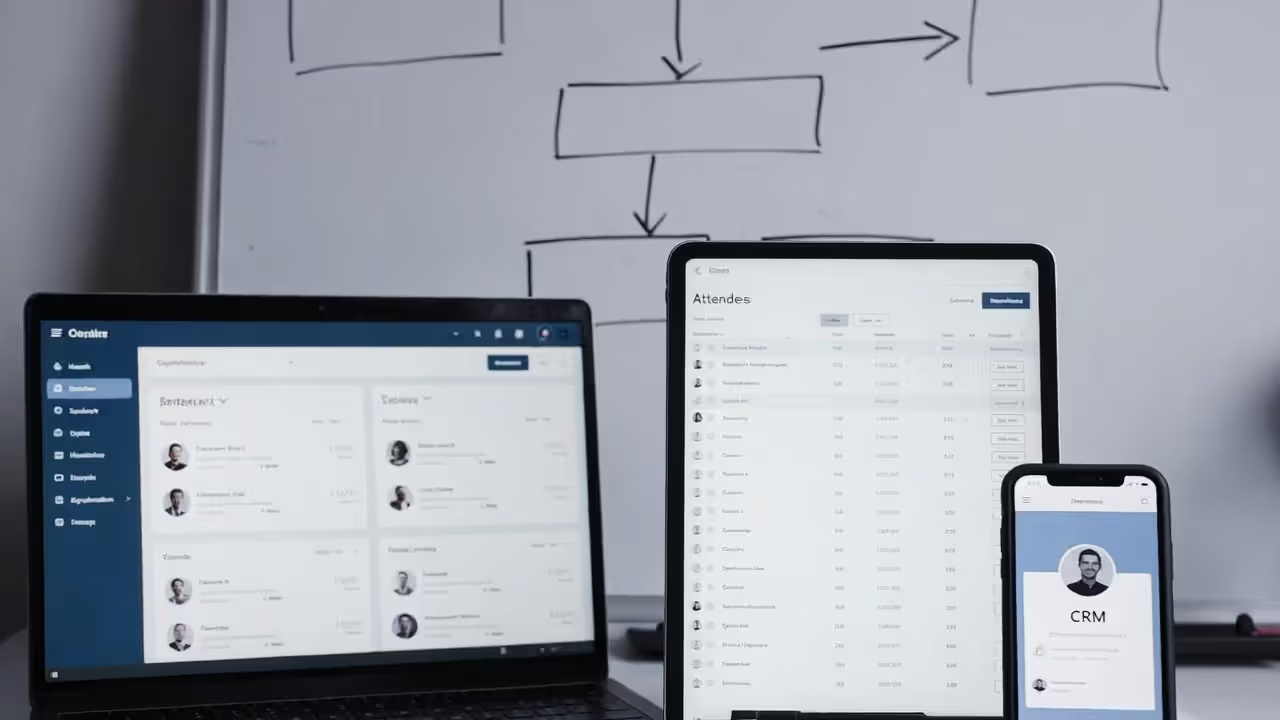
Comprehensive engagement tracking requires connecting multiple data sources into a unified view.
Your event platform—whether Cvent, Bizzabo, Hopin, or similar—captures registration, session attendance, and basic interaction data. This forms your foundation, but it's incomplete without context from other systems.
Mobile event apps track granular engagement: session ratings, resource downloads, poll responses, networking activity, and navigation patterns. Choose apps that export data in usable formats rather than trapping it in proprietary dashboards. Integrations with your CRM and marketing automation platform turn engagement data into actionable audience segments.
Badge scanning technology for in-person events captures booth visits, session entry/exit times, and networking connections. RFID and NFC badges provide passive tracking without requiring attendees to actively scan. Bluetooth beacons offer similar capabilities with existing attendee smartphones.
Survey and feedback tools—Typeform, SurveyMonkey, or native platform tools—collect qualitative data that explains quantitative patterns. Why did people love one session and hate another? What prevented them from networking more? Which topics should you cover next time?
CRM integration closes the loop between event engagement and business outcomes. Salesforce, HubSpot, and similar platforms should automatically tag event attendees, log their engagement level, and trigger appropriate follow-up workflows. Someone who attended 8 sessions and made 15 connections deserves different outreach than someone who registered but never showed up.
Marketing automation platforms use engagement data for segmentation and personalization. Send session recordings only to people who attended related sessions. Invite highly engaged attendees to exclusive follow-up events. Nurture low-engagement attendees differently than your champions.
Data warehousing and analytics platforms—whether Snowflake, Google BigQuery, or specialized event analytics tools—aggregate data from multiple sources for comprehensive analysis. This becomes essential for multi-event programs where you need to track engagement patterns across quarters or years.
Implementation reality check: start simple. Many event organizers try to track everything immediately and end up tracking nothing effectively. Begin with 5-7 core metrics that align with your primary event goals. Add sophistication as your team develops analytical capabilities.
The minimum viable analytics stack for a mid-sized corporate event:
- Event platform with session tracking
- Mobile app with networking features
- Post-event survey
- CRM integration for attendee tagging
- Spreadsheet or dashboard for unified reporting
Expand from there based on specific needs and demonstrated ROI from analytics investment.
Benchmarking Your Event Performance: What Good Engagement Actually Looks Like
Context determines whether your metrics indicate success or failure. A 40% session attendance rate might be excellent for a 5,000-person conference but terrible for a 50-person executive roundtable.
Event format dramatically impacts expected engagement. Virtual events typically see lower sustained engagement than in-person events because attendees multitask and drop off more easily. Hybrid events face the challenge of creating equivalent experiences for both audiences.
| Event Type | Session Attendance Rate | Q&A Participation Rate | Networking Connections Per Attendee | Content Download Rate | Post-Event Survey Response |
| In-Person Conference (500+ attendees) | 60-75% | 15-25% | 8-12 | 30-40% | 20-30% |
| Virtual Conference (500+ attendees) | 40-55% | 10-18% | 4-7 | 45-60% | 15-25% |
| Hybrid Conference (500+ attendees) | In-person: 65-80%, Virtual: 35-50% | 12-20% | In-person: 10-15, Virtual: 3-6 | 40-55% | 18-28% |
| Executive Roundtable (20-50 attendees) | 85-95% | 60-80% | 15-25 | 50-70% | 40-60% |
| Trade Show / Expo | 50-70% (booth zone) | 8-15% | 12-20 | 25-35% | 12-20% |
Industry vertical affects benchmarks. Technology and software events typically see higher digital engagement (app usage, content downloads) than industries less comfortable with event technology. Healthcare and financial services events often have lower social media sharing due to compliance concerns, but that doesn't indicate lower value.
Event maturity matters. Your first annual event will underperform your fifth because you haven't yet built community, optimized programming, or developed reputation. Expect 20-30% lower engagement in year one compared to established events in your category.
Audience seniority influences participation patterns. C-level executives attend fewer sessions but make higher-quality connections. Individual contributors attend more sessions but may network less strategically. Design different success indicators for different audience segments.
Warning signs that indicate serious engagement problems:
- Session attendance dropping below 40% for in-person events
- Q&A participation under 8% despite active moderation
- Post-event survey response below 12%
- Average session duration under 50% of scheduled time
- Networking connections under 3 per attendee for multi-day events
- Content download rates below 20%
These thresholds suggest fundamental issues with content relevance, audience targeting, or event design rather than normal variance.
Compare your performance against your own historical data more than industry averages. Improving your Q&A participation from 12% to 18% year-over-year matters more than matching someone else's 20%. Focus on trend lines and continuous improvement.
The events industry spent decades optimizing for attendance and hoping engagement would follow. The shift to virtual events during the pandemic forced us to measure what actually matters because we could finally see exactly how people interacted with content and each other. That transparency won't—and shouldn't—disappear as we return to in-person events. Data-driven event strategy isn't about collecting more metrics; it's about understanding which attendee behaviors create real business value and designing experiences that generate more of those behaviors.
— Sarah Chen, VP of Marketing, EventTech Summit
Common Event Metric Mistakes That Skew Your Success Indicators
Data without context misleads. Several common errors cause event organizers to misinterpret their results and make poor decisions.
Survivorship bias affects session ratings dramatically. Only engaged attendees complete session surveys, creating artificially high satisfaction scores. A session rated 4.5/5 by 30% of attendees might actually indicate that 70% found it so unremarkable they didn't bother rating it. Weight ratings by response rate to get realistic quality assessments.
Selection bias skews networking metrics when only motivated attendees use networking features. If 40% of attendees actively use your meeting scheduler and they average 10 connections each, you can't extrapolate that the entire audience networked effectively. The other 60% might have made zero meaningful connections.
Correlation versus causation trips up ROI analysis. Attendees who engage heavily with your event also tend to be your most motivated customers or prospects. They would likely convert at higher rates regardless of event attendance. Comparing event attendees to non-attendees without controlling for prior engagement level overstates event impact.
One company attributed $12M in revenue to their user conference based on deals closed by attendees within 90 days. But when they compared attendee conversion rates to similar prospects who didn't attend, the difference was only 8%. The conference accelerated some deals but didn't create most of that revenue—they confused correlation with causation.
Sampling errors occur when you draw conclusions from non-representative groups. Early survey responses come from your most engaged (or most dissatisfied) attendees. Waiting until you hit 25-30% response rate before analyzing results provides more reliable insights.
Recency bias causes overweighting of the final event moments. The closing keynote or last-night party disproportionately affects overall satisfaction ratings. Track sentiment throughout the event, not just at the end, to identify which specific elements worked or failed.
Metric gaming happens when teams optimize for measured numbers rather than actual goals. If you measure booth traffic, sponsors will hire booth babes and run giveaways that generate foot traffic without meaningful conversations. If you measure session attendance, organizers will schedule popular speakers in small rooms to create "sold out" sessions rather than ensuring everyone who wants to attend can access content.
Incomplete attribution windows cut off measurement too early. Measuring event ROI at 30 days captures quick wins but misses deals with longer sales cycles. B2B events often show their full impact over 6-12 months. Set measurement windows appropriate to your sales cycle length.
Ignoring statistical significance leads to overreacting to noise. If session ratings vary between 4.2 and 4.4 across ten sessions, that's likely random variation, not meaningful quality differences. Understand confidence intervals before making programming changes based on small rating differences.
The solution: combine quantitative metrics with qualitative feedback, compare results to appropriate benchmarks, and focus on trends over time rather than single data points. Treat your first few events as calibration—learning what normal looks like for your specific audience before drawing strong conclusions.
FAQ: Event Engagement Metrics
Event engagement metrics transform guesswork into strategy. Counting registrations and hoping for the best wastes budget on experiences nobody values. Measuring what attendees actually do—which content they consume, who they meet, how they behave afterward—reveals what works and what needs fixing.
The metrics that matter most depend on your event's purpose. A lead generation event needs different success indicators than a customer retention event or an industry thought leadership conference. Start by defining what success looks like for your specific goals, then select metrics that measure progress toward those outcomes.
Build your measurement capabilities gradually. Begin with basic engagement tracking—session attendance, interaction rates, post-event surveys—and add sophistication as you learn what insights drive better decisions. Perfect data collection matters less than consistent measurement and willingness to act on what you learn.
The real value of engagement tracking isn't the numbers themselves—it's the conversations those numbers enable. When you can show stakeholders exactly which event elements generated pipeline, strengthened relationships, or accelerated deals, you transform events from cost centers into strategic investments. That shift changes how organizations think about events and how much they're willing to invest in creating genuinely valuable experiences.
Stop measuring attendance and start measuring engagement. Your attendees, your budget, and your career will benefit.